

The Most Important Japanese Knife Shapes for a Home Kitchen
Gyuto, Santoku, Bunka, Nakiri, Petty, Sujihiki, Honesuki, Yanagiba, Deba, Usuba - once you start exploring Japanese knives, a simple purchase can quickly turn into a list of unfamiliar shapes.
The good news is that most home kitchens do not need a large collection of Japanese knives. One properly chosen main knife can perform roughly 80% of normal cooking. A second knife should add a capability that the first one genuinely lacks, and specialist shapes should normally appear only when a repeated task starts to justify them.
That is the framework behind this guide. Instead of asking which silhouette looks most Japanese, most professional or most impressive, ask something much more useful: what job will this knife make easier, safer or more efficient than the knives I already own?
If the answer is unclear, there is a good chance that the new knife adds variety rather than capability. There is nothing wrong with collecting knives for enjoyment, but it helps to understand which kind of purchase you are making.
If you are still exploring the categories, you can also browse Japanese knives by shape while reading this guide.

How many Japanese knives do you actually need?
For many people: one. A good Gyuto, Santoku or Bunka can cover the majority of normal home cooking.
Add a Petty or Paring knife when small work becomes inconvenient with the main blade. Add a Nakiri, Sujihiki, Honesuki or another specialist only when a repeated task clearly justifies it.
For a surprisingly large number of home cooks, one main Japanese knife + one small knife + a bread knife is already a complete working set. You do not need five or ten knives simply because five or ten shapes exist.
If we could keep only five Japanese knife shapes
If we had to reduce the entire world of Japanese kitchen knives to five shapes that create the most useful range of capabilities at home, we would keep Gyuto, Petty, Nakiri, Bunka and Sujihiki.
Gyuto is the full-size all-rounder. Petty covers the small jobs that a main knife handles poorly. Nakiri adds a genuinely different vegetable-focused platform. Bunka gives us a compact multipurpose knife with a precise tip and relatively flat working profile. Sujihiki adds a long, narrow blade for clean slicing through meat and fish.
This does not mean that every home should buy all five. In fact, most should not. The point is that these shapes can create genuinely different capabilities instead of simply filling a rack with slightly different multipurpose knives.
General-purpose knife or specialist?
A general-purpose knife should perform roughly 80% of your normal cooking without forcing an awkward technique. Gyuto, Santoku and Bunka can all fill that role for different users.
A specialist should solve a repeated problem noticeably better. Nakiri should make frequent vegetable prep easier. Sujihiki should improve long slicing cuts. Honesuki should make regular poultry breakdown more controlled. Yanagiba should offer something meaningful to somebody who repeatedly practices traditional fish slicing.
A useful question before buying another knife is therefore: what does my current knife make slow, clumsy or inconvenient? If the answer is “small trimming”, add a Petty or Paring knife. If the answer is “I chop a mountain of vegetables every day”, Nakiri becomes interesting.
If the answer is “nothing, I just like the look of the other knife”, then you are making a perfectly valid hobby purchase - but not expanding the functional range of the kitchen.
The food you actually cook matters more than the silhouette
Meal style should strongly influence shape. Vegetable-heavy cooking rewards flat profiles, useful blade height and efficient board contact. Large cuts of meat reward extra length. Whole poultry can justify Honesuki. Serious fish breakdown can eventually justify Deba, while repeated clean slicing can make Sujihiki or Yanagiba useful.
Baking is a good reminder that not every useful knife needs to be another Japanese multipurpose shape. If you bake your own bread or regularly buy fresh crusty loaves, a proper serrated bread knife may add more real capability than another Santoku, Bunka or Gyuto.
For example, a dedicated 27 cm Tojiro bread knife solves a task that even an expensive thin Gyuto simply does not solve as well.
Buy for the food you actually prepare, not for the knife shapes that happen to photograph best.
Technique narrows the choice
Ingredients define the broad need, but cutting technique helps narrow the profile. Push cutting and straight chopping generally work well with flatter edges. A pronounced rocking technique needs more belly and enough tip clearance for the knife to move through the arc cleanly.
Technique should not override function. A perfectly flat knife is still a poor choice if it is too short for the products you cut every day, and a curved Gyuto is not automatically right simply because you learned to rock a Western chef's knife.
The best choice is where food, technique, workspace and ergonomics meet.
Your kitchen and cutting board can rule out a knife
A 24 cm Gyuto may be an excellent knife and still be completely wrong for a narrow cutting board in a tiny apartment. The blade, the food and the cutting stroke all need space.
In the same kitchen, a 16.5-18 cm Santoku or Bunka can suddenly feel natural. The shorter knife is not objectively better - the environment simply allows it to work properly.
This is particularly important when people choose by specifications online. The board has to fit the knife, the ingredient and some safe working clearance around both.


Gyuto: the broadest one-knife recommendation
For the widest range of home cooks, a 21 cm Gyuto is still our safest one-knife recommendation. It has enough length for cabbage, squash, larger vegetables and substantial cuts of meat, while retaining a useful pointed tip for onions, garlic, trimming and detailed work.
Its biggest strength is the ability to move between different scales of cooking. A 21 cm Gyuto can start as a simple all-rounder for a beginner and later handle faster prep, larger ingredients, longer slicing strokes and more precise tip work as the user's technique develops.
That is why Gyuto is also one of the shapes least likely to be outgrown.
When does a 24 cm Gyuto make sense at home?
A longer Gyuto becomes particularly useful for large meat portions, high-volume prep and people who regularly cook for larger groups. Extra edge length reduces the number of strokes needed to move through large ingredients.
Our personal preference often moves toward 24 cm Gyuto when there is enough board space. The length is useful on meat, while the flatter heel section can still work very well on herbs and vegetables. A long knife that is light and well balanced can feel surprisingly agile.
This also explains why “small hands need a short knife” is too simplistic. A balanced 24 cm Gyuto can feel better in a small hand than a shorter, handle-heavy Santoku.
Length alone never tells the whole handling story.

Santoku: one of the easiest shapes for a beginner
Santoku is compact, predictable and easy to control on a smaller board. A typical 16-18 cm Santoku often feels immediately comfortable to somebody who does not need the extra length of a full-size chef's knife.
It is particularly natural when meals are prepared for one or two people, the kitchen is narrow or the user simply prefers a shorter blade. The taller heel often provides good knuckle clearance relative to the overall size.
Its limitation becomes visible with larger ingredients. Big pieces of meat, whole cabbage, large fish or longer slicing jobs expose the shorter edge much sooner than they do on a 21 cm Gyuto.

Why is Santoku low in our overall ranking if it is so good for beginners?
Because “great first knife” and “useful additional shape” are two different questions.
Santoku can be one of the safest first Japanese knives. But if someone already owns a good 18-21 cm Gyuto, buying a Santoku of similar length often adds relatively little functional range. Both knives perform much of the same mixed board work.
That is why Petty and Nakiri can rank above Santoku in our average-home list. They are more complementary to an existing Gyuto.
Santoku is a strong main knife. It is not automatically the strongest second knife.
The myth that your first Japanese knife has to be Santoku
Santoku is popular, compact and beginner-friendly, so it is easy to turn that popularity into a rule: “your first Japanese knife should be Santoku”. We do not think that rule exists.
A person preparing large mixed family meals may be much happier with Gyuto. A vegetable-heavy cook may discover that Nakiri actually performs most of their real workload better. Someone using a narrow board and compact ingredients may genuinely prefer Santoku.
The popularity of one shape should never replace the conversation about how the knife will be used.
A pattern we regularly see in the shop
Customers sometimes arrive convinced that Santoku is what they need because it is the Japanese shape they recognise. After comparing several knives, a 21 cm Gyuto can turn out to feel more comfortable because of its balance, handle and working length.
The reverse happens as well. Someone expects to want a chef's knife and immediately prefers the control of a compact Santoku.
This is why we stopped treating blade length as a direct extension of hand size. Balance and height often explain more about handling than the number printed in the product name.
Bunka: compact all-rounder with a different personality
Bunka occupies much of the same compact multipurpose territory as Santoku, but usually combines a flatter working profile with a sharp k-tip.
The shape becomes meaningfully different when those characteristics are actually used. Someone who mostly push cuts, chops herbs and appreciates precise point work can get a great deal from Bunka. The pointed tip works well for onions, scoring, trimming and controlled entry cuts.
If the user mostly performs a pronounced rocking motion, the same knife can be less natural. A very flat edge resists the rocking arc and the low point can repeatedly contact the board.
What does the k-tip actually add?
A fine, low point lets the user see exactly where the blade enters the product. It is excellent for onion work, garlic, scoring, small trimming jobs and controlled precision cuts.
A rounded or higher tip is usually more forgiving when rocking, but can feel less precise in very tight work. The finest possible point is not automatically better - it is only useful if the owner's technique allows it to survive.
The downside of the fine Bunka tip
There is less steel supporting the point. Twisting, scraping sideways or striking the board carelessly can bend or chip it. Users coming from a Western chef's knife can also drive the point into the board while trying to force a familiar rocking motion onto a much flatter profile.
A good Bunka rewards precision. It also exposes sloppy lateral movement quickly.


Tsukasa Tokaji Shirogami #1/Iron Bunka 17 cm makes the shape easy to understand: compact working length, relatively flat edge and a very distinct k-tip.
Bunka and Kiritsuke are easy to buy with your eyes
Aggressive points photograph well. Bunka and Kiritsuke-style silhouettes are therefore among the knives most likely to be purchased because of appearance rather than because the buyer needs a new function.
If you already own another universal knife of similar length, ask what the new Bunka changes. If the answer is “I want flatter push cutting and precise k-tip work”, there is a functional reason. If the answer is only “I like how aggressive it looks”, then it is primarily a hobby purchase.
Again, nothing is wrong with that. The important part is knowing which decision you are making.

Nakiri: a shape many home cooks underestimate
Nakiri becomes much more useful than another multipurpose knife when vegetable prep is frequent and substantial. Its height and relatively flat cutting edge work well for repeated push cuts, vertical chopping and moving ingredients across the board.
It is also one of the shapes people sometimes overlook because its rectangular silhouette gets confused with a Chinese cleaver. The similarity is mostly visual. Nakiri is a vegetable-focused Japanese knife and is normally much thinner and lighter than the heavy cleaver many people imagine when they first see the profile.
For someone who cooks mostly vegetables, fruit and herbs, Nakiri can even become the primary board knife.


Hatsukokoro Ginrei Nashiji Gingami No.3 Nakiri 16 cm is a useful illustration of the vegetable-first shape: enough height for knuckle clearance and ingredient transfer, while keeping a compact working length.
Can Nakiri be the main knife in a vegetarian or vegan kitchen?
Definitely. If the majority of the workload is vegetables, fruit and herbs, Nakiri can perform a huge percentage of everyday prep efficiently.
The limitation is the missing conventional point. Coring small produce, trimming, scoring, working around connective tissue or making a precise entry cut is less natural.
That is why Nakiri + Petty can be a more useful vegetable-focused combination than forcing one universal knife to perform every task.
A taller blade is not automatically better
Nakiri also illustrates why blade height has both advantages and disadvantages. More height creates knuckle clearance and gives the user a broad surface for moving chopped ingredients.
But increasing side area can also increase drag, add weight and give wet ingredients more surface to stick to. Extremely tall knives can feel less precise near the front.
Comfort depends on the entire geometry and balance - not simply on maximizing blade height.
Petty: probably the most underrated second knife
Petty sits unusually high in our ranking because it fills the gap below the main knife instead of competing with it.
A 12-15 cm Petty is useful for shallots, citrus, small fruit, trimming, small portions and tight board work. It prevents the user from constantly reaching for a thin full-size Gyuto when the task is simply too small to justify it.
That is why the classic combination of 21 cm Gyuto + 12-15 cm Petty remains difficult to beat. The functions overlap very little.


Petty vs Paring: similar territory, different use
Petty and Paring knives overlap, but they should not be treated as identical.
A Petty is usually around 12-15 cm and primarily performs small work on the board: slicing, trimming and portioning. A Paring knife is usually much shorter - often around 6-10 cm - and becomes more natural for peeling, coring and controlled work where the ingredient is held in the hand.
If “small work” means small board work, Petty is usually our first recommendation. If it means peeling and in-hand carving, Paring makes more sense.


The most common wrong second knife
The most common mistake is buying a second knife that is functionally very close to the first one. Somebody owns a good 18 or 21 cm Gyuto and immediately buys a Santoku of similar length. Or they already own a versatile compact knife and add another compact universal knife with a different tip.
The other version of the same mistake is buying a specialist before the specialist's task actually exists - for example, a Yanagiba for somebody who almost never prepares fish.
Before buying the next knife, identify the missing task first.
If you already own Gyuto, what should come next?
Small board work: Petty.
Peeling and in-hand work: Paring.
Large quantities of vegetables: Nakiri.
Long slicing through roasts or fish: Sujihiki.
Regular whole poultry: Honesuki.
Fresh bread and baking: a serrated bread knife.
The correct second knife is the one that solves the job your Gyuto handles least comfortably.
What if the first knife is Santoku or Bunka?
If most cooking is vegetables and the compact main knife already performs that job well, a Petty is still a very logical complement.
If the user prepares large portions of meat, the missing capability may instead be length. In that case a 24 cm Gyuto or a long Sujihiki can add far more than another compact knife.
Again: buy the missing capability, not the next shape on a checklist.
Sujihiki: a specialist that earns its place through repeated slicing
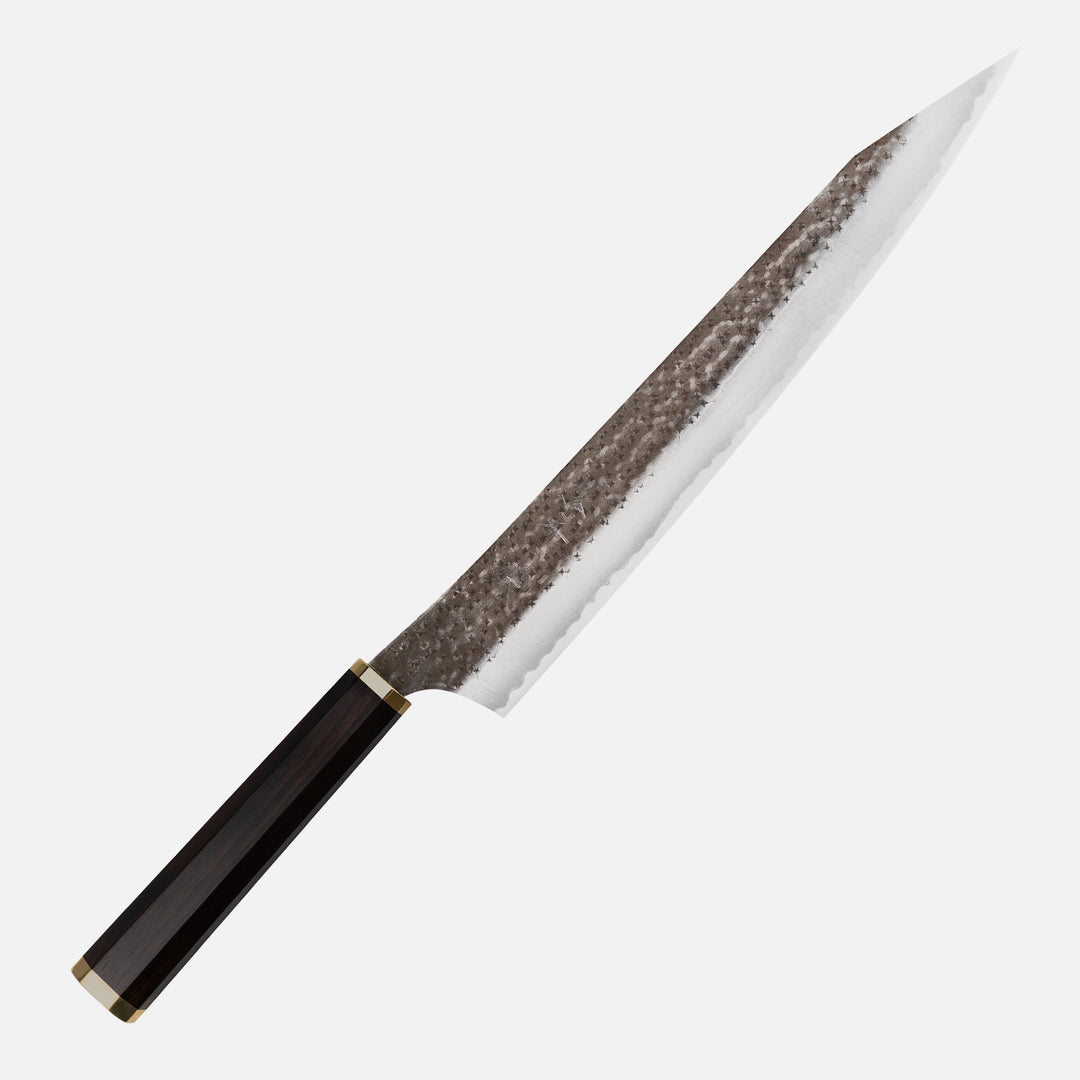
Sujihiki is designed around long, clean draw cuts. It makes sense for somebody who regularly slices roasts, brisket, cured meats, large boneless fish or other proteins where a long narrow edge reduces unnecessary sawing.
For occasional meat, a sufficiently long Gyuto already performs the task well enough. Sujihiki becomes valuable when those long slicing cuts happen repeatedly.
Honesuki: useful when poultry is actually frequent
Honesuki is designed for poultry breakdown: accessing joints, working close to bone, removing meat and controlling short precise movements.
It is not designed to behave like a heavy bone cleaver. The goal is controlled work around joints rather than chopping straight through large bones.
If whole chickens or other birds are broken down every week, Honesuki can be a meaningful improvement. If the job appears once every few months, a suitable robust Petty is much easier to justify.

How often should you use a specialist before buying one?
There is no strict mathematical threshold, but frequency is a useful reality check.
If you prepare sushi once or twice every month and genuinely enjoy learning traditional fish preparation, a dedicated specialist can make sense. If you make sushi twice a year, buying Yanagiba is much harder to justify as a functional necessity.
The same rule applies to Honesuki, Deba and other specialist shapes. A repeated job creates the value.
The rarer the task, the more the purchase becomes hobby rather than necessity.
Yanagiba: one of the biggest specialist upgrades when it is justified
Yanagiba can provide a substantial improvement when long, controlled slicing of fish is performed regularly. The long blade allows the user to make a clean draw cut without repeated sawing.
For most home sushi enthusiasts, however, a double-bevel Sujihiki is the easier first step. It is more forgiving to steer, easier to sharpen for somebody used to double-bevel knives and useful for far more than sushi.
Yanagiba becomes interesting when single-bevel technique itself becomes part of the hobby or repeated practice.
Our personal sweet spot is often around 27 cm. This is a personal preference rather than a universal law, but that length gives enough cutting edge to show why the specialist shape exists in the first place.

Deba: one of the specialists we see purchased too early
Deba is another fascinating traditional shape, but it is frequently bought before the user has enough work to justify it.
A common problem is going straight for a large 18-20 cm Deba when the buyer mostly prepares much smaller fish. The knife then feels cumbersome for the actual products and spends most of its life unused.
Deba should be matched not only to the fact that you prepare fish, but also to the size of fish and frequency of breakdown.

What about Usuba?
Usuba belongs in the same general warning category as Yanagiba and Deba: a fascinating traditional specialist that most ordinary home kitchens do not need.
Its single-bevel geometry and vegetable-focused technique can be extremely rewarding in the right hands, but an ordinary double-bevel Nakiri is much easier and more forgiving for someone who simply wants an efficient vegetable knife.
The fact that a knife is deeply connected to Japanese culinary tradition does not automatically make it the best tool for casual home cooking.

Profile: push cutting, chopping and rocking
A flatter edge creates more board contact during a push cut or straight chop. That can reduce uncut sections when working through herbs and vegetables.
More belly gives a knife enough clearance to rock without repeatedly driving the tip into the board. A slight curve toward the front can create a useful compromise: relatively flat board contact at the heel with enough curvature near the tip to allow some rocking movement.
Neither profile is inherently superior. The right one is the profile that matches the motion the user actually repeats.
A flatter Bunka naturally favours push cutting, while a Gyuto with more belly allows more rocking movement.
Tip shape changes precision
A low, fine point lets the user see exactly where it enters the product. This makes detailed work around onions, garlic and small ingredients extremely controlled.
A higher or rounder tip is less delicate and can tolerate rocking more naturally, but may feel less precise in tight work.
The most extreme tip is not necessarily the best tip. It has to match the user's technique.
Blade height: knuckle clearance, weight and drag
A taller blade gives more room for the knuckles and creates a larger side surface that can be useful for moving ingredients. But height also changes mass, drag and food sticking.
A lower blade can feel quicker and more precise, but may crowd the hand against the board.
This is why two knives with the same nominal 18 cm length can feel completely different. Height, profile and tip position change the way the entire blade interacts with the hand and board.
Small hands do not automatically need short knives
Hand size should be considered, but it is not a formula for blade length. Handle dimensions, total weight, balance and blade height often matter just as much.
A longer knife with a light handle and neutral balance may be very comfortable for a small hand. A shorter knife with a heavy Western handle may feel more cumbersome.
The board is often the final limiting factor. If there is not enough room to use the longer edge safely, then the ergonomics no longer matter - the knife is simply too large for the workspace.
Wa vs Western/Yo handle
Handle construction can dramatically change the perceived personality of the same blade shape.
A lighter Wa handle often leaves more mass toward the blade and makes the knife feel blade-forward. A heavier Western handle can pull the balance backward and feel more familiar to users accustomed to European knives.
The handle does not change the actual edge profile, but it can strongly affect control, perceived weight and fatigue.

Wa and Western handles can change balance and perceived weight considerably even when the blade itself performs a similar role.
Coming from a Western chef's knife?
A user accustomed to a European chef's knife often needs to change expectations when moving to flatter Santoku, Bunka or Nakiri profiles.
Use shorter push cuts or clean vertical chopping instead of forcing a pronounced rocking stroke. Do not twist a thin hard edge sideways to free it from dense food, and do not use the cutting edge to scrape chopped ingredients across the board.
A flatter Japanese profile rewards clean board contact - but it also reveals sloppy movements more quickly.
A simple in-store test: Gyuto vs Santoku vs Bunka
Grip the knife the way you actually plan to use it. Check whether the handle feels natural and whether your knuckles clear the board without lifting the wrist.
Then simulate a few push-cut movements and a few rocking movements. Notice where the edge contacts the board and whether the point feels natural or intrusive.
Finally, pay attention to balance and perceived weight. This simple test often reveals more than comparing steel names or blade lengths on a product page.
Three users, three different recommendations
A small-apartment cook working on a narrow board and primarily using push cuts may be happiest with Santoku or Bunka.
A person preparing large portions of meat and mixed family meals is much more likely to benefit from 21-24 cm Gyuto.
A vegetable-heavy cook using repeated vertical chopping may genuinely find Nakiri + Petty more useful than another all-purpose knife.
This is why the answer to “which Japanese knife is best?” changes as soon as the actual user appears.
If you can buy only one good Japanese knife
The three safest options are straightforward. Choose Gyuto for the broadest range and larger work, Santoku for compact control and smaller workspaces, or Bunka when a similarly compact knife with flatter cutting and a precise k-tip genuinely matches your technique.
Nakiri enters the one-knife conversation mainly for somebody whose cooking is overwhelmingly vegetable-based.
The best minimalist two-knife setup
For maximum coverage with minimum overlap, we keep coming back to 21 cm Gyuto + 12-15 cm Petty.
Gyuto covers almost all large board work. Petty deals with smaller ingredients and tighter tasks. If the small work is mostly performed in the hand, replace or supplement Petty with Paring.
This is a functional set rather than a collection of shapes.
Gyuto + Petty remains one of the strongest minimalist home setups because the two knives work on genuinely different scales.
The best three-knife setup for an enthusiast
For somebody who cooks almost every day, a very strong setup is 21-24 cm Gyuto + Nakiri + 12-15 cm Petty.
One universal main knife, one genuine vegetable specialist and one small precision knife. Very little functional overlap.
A strongly meat-focused cook could replace Nakiri with Sujihiki.
Mostly vegetables?
Nakiri + Petty is an excellent combination. Nakiri performs the repetitive board work, while Petty restores the pointed precision that Nakiri lacks.
If you insist on only one knife, Bunka or Santoku is usually safer because both retain a useful point and broader range.
Mostly meat?
A 24 cm Gyuto plus Petty or Paring covers portioning, trimming and general prep very effectively.
Add Sujihiki only when long clean slices become a regular part of cooking. Add Honesuki only when whole poultry breakdown becomes regular.
Tiny apartment kitchen?
A compact Santoku or Bunka plus Petty/Paring gives a large functional range without allowing the main knife to dominate a narrow cutting board.
There is little point buying 24 cm purely because somebody online says serious cooks use long knives if the kitchen does not provide enough room to move it.
Hosting large dinners and doing high-volume prep?
This is one of the home situations where a light 24 cm Gyuto starts making a lot of sense. Pair it with roughly 15 cm Petty.
If the workload is dominated by vegetables, add Nakiri. If large proteins dominate, Sujihiki becomes the more useful specialist.
Length saves strokes only when the board is large enough to use it.
One excellent knife or two cheaper ones?
If the customer does not yet own a genuinely good main knife, we would normally spend most of the budget there first.
Once the main knife has good geometry, a comfortable handle and sensible weight distribution, a simpler Petty can be added without spending the same amount again.
The exception is somebody who already knows that the small knife will be used almost as much as the main knife. In that case splitting the budget more evenly can make sense.
Do not buy two mediocre knives simply so that you can call them a set.
What would we sacrifice first to stay within budget?
Steel prestige and maker prestige come before geometry.
A simpler steel with excellent geometry can cut better than a prestigious alloy in a thick, poorly balanced blade. Edge retention may be lower, but the difference in cutting performance is something the owner feels at every meal.
Decorative finish and expensive handle materials are also easier sacrifices than good weight distribution or a comfortable working profile.
We would rather buy a simple laser than an expensive axe.
What is over-marketed in knife selection?
Aggressive silhouettes, exotic steel names, very high HRC values and decorative finishes are easy to show in a photograph or specification table.
None of them fixes the wrong length, bad knuckle clearance, poor weight distribution or a profile that fights the owner's cutting technique.
An extremely hard steel cannot repair an uncomfortable handle. Damascus cannot fix a knife that is too thick for the kind of cutting you expect from it.
What is underrated?
Blade height, balance, edge profile and board size.
These affect every cut and every movement, yet buyers regularly start by comparing steel and decorative patterns.
A cheaper knife that fits the hand, technique and workspace can easily be the better tool.
Our practical rankings
| Rank | Average home kitchen | Vegetable-heavy kitchen | Meat-heavy kitchen |
|---|---|---|---|
| 1 | Gyuto | Nakiri | Gyuto |
| 2 | Petty | Bunka | Petty |
| 3 | Nakiri | Gyuto | Santoku |
| 4 | Santoku | Santoku | Bunka |
| 5 | Bunka | Petty | Nakiri |
The unusual part of the average-home ranking is Petty at number two and Santoku at number four. That placement is deliberate. Petty adds a genuinely smaller capability to a kitchen that already has Gyuto, while Santoku is an excellent first knife but can duplicate much of an existing Gyuto's role.
Nakiri reaches third place because we think it is more useful than many buyers expect. When vegetable and herb work is substantial, the difference is real.


Five representative models - one for each major role
Sakai Takayuki Hammered VG-10 Gyuto 21 cm demonstrates the full-size all-rounder.
Terakazu Takamura Brown Chromax Santoku 16.5 cm shows compact control and thin cutting geometry.
Tsukasa Tokaji Shirogami #1/Iron Bunka 17 cm makes the flatter working section and k-tip obvious.
Hatsukokoro Ginrei Nashiji Gingami No.3 Nakiri 16 cm demonstrates the vegetable-first concept.
Hatsukokoro Hayabusa Tsuhime VG-10 Petty 15 cm fills the gap below the main knife.
Three very different approaches from the range
Kanetsune 100 Damascus VG-10 Gyuto 21 cm represents a straightforward one-knife setup: useful length, stainless care and broad functionality.
Terakazu Takamura Brown Chromax Santoku 16.5 cm represents a compact, thin-cutting solution for somebody working carefully on a smaller board.
Ono Suzukaze SG2 Nakiri 16.5 cm represents the vegetable-first approach: more specialized, taller and deliberately different from an all-purpose knife.
When does a premium Bunka make sense?
A knife such as Hado Sumi Shirogami #2/Iron Bunka 17 cm makes the most sense after the owner already knows that they genuinely like compact working length, a relatively flat edge and precise k-tip use.
Buying it only because the profile looks aggressive wastes much of what makes the knife special.
Premium becomes easier to justify once the preference itself is specific.
What changes with experience?
With experience, we stopped treating every new shape as a new capability. Different silhouettes can still perform substantially the same work.
We also stopped linking hand size directly to blade length. Balance, handle design and blade height explain much more than we originally gave them credit for.
The recommendation for an experienced user changes too. Instead of saying “buy Gyuto” or “buy Santoku”, we can start discussing character: true laser, heavier workhorse, carbon steel, 24 cm Gyuto, very flat Bunka or a specialist matched to a known task.
An experienced user understands the compromise and does not need the knife to forgive every mistake. But experience does not create an obligation to choose a more demanding knife.
What would we recommend to a beginner?
A predictable main knife: usually a stainless 21 cm Gyuto or practical Santoku, moderate hardness, comfortable handle and sensible geometry.
The beginner benefits from a knife that allows technique to develop without making every small mistake expensive.
An ultra-thin edge, fully reactive steel or very delicate k-tip can come later once the user knows whether those characteristics are actually desirable.
A real customer example: Santoku became Bunka
One customer came in specifically looking for Santoku. During the conversation it became clear that he almost never rocked the knife, regularly used push cuts and chopped herbs frequently.
Bunka made more sense. The flatter working section matched his repeated movement better, while the sharp point still gave him useful precision.
That does not make Bunka universally better than Santoku. It shows why the actual technique can change the recommendation completely.
Our personal TOP 3
If we ignore popularity and marketing, our own podium starts with 24 cm Gyuto, followed by Bunka and Nakiri.
Gyuto wins because the extra length is useful for larger meat cuts and mixed prep while still retaining a precise front section. Bunka gives a compact, flatter option without sacrificing the point. Nakiri becomes exceptional when vegetables and herbs dominate the board.
This ranking is a preference built from experience, not a universal hierarchy. Someone else's kitchen can produce a completely different top three.


A simple buying framework
First knife: choose the main knife that comfortably performs most of your real cooking.
Second knife: add a genuinely missing capability, not another version of the first knife.
Specialist: buy it when the specialist task appears regularly enough to justify the space and learning curve.
Premium: spend more once you know exactly which geometry, balance and character you prefer.
Never expect shape or price to override physics: thin Japanese knives are still the wrong tools for frozen food, bones, prying and scraping the cutting board with the edge.
FAQ - Japanese knife shapes for a home kitchen
1. Gyuto or Santoku for home use?
Choose Gyuto for greater range, larger products and more room to grow. Choose Santoku for compact control, smaller cutting boards and a shorter working length.
2. Bunka or Santoku?
Choose Bunka if a flatter edge, push cutting and precise k-tip work suit your technique. Santoku is generally more forgiving if you still use some rocking motion and do not need a very fine point.
3. Do I need Nakiri if I already own Gyuto?
Only if vegetable and herb prep is frequent enough that the tall, relatively flat specialist will genuinely be used. For low-volume mixed cooking, Gyuto already performs vegetable work very well.
4. What size Japanese knife is best for a small kitchen?
A 16-18 cm Santoku or Bunka often makes more sense on a narrow board than a 24 cm Gyuto. The board and available workspace should always be considered together with blade length.
5. Petty vs Paring - which should I buy?
Choose Petty for small board work, trimming and slicing. Choose a shorter Paring knife when peeling, coring or controlled in-hand work makes up most of the task.
6. How many Japanese knives do I need?
One good main knife can cover most home cooking. For many users, Gyuto, Santoku or Bunka plus Petty or Paring and a bread knife already creates a very complete working set.
7. Is Gyuto always better than Santoku?
No. Gyuto has fewer limitations when large ingredients and long cuts are common, while Santoku can be more comfortable in limited space or for somebody who genuinely prefers a compact knife.
8. Do small hands need a short knife?
Not automatically. Handle shape, balance, blade height, overall weight and cutting-board size can matter as much as blade length.
9. When does Sujihiki make sense at home?
When long slicing cuts through roasts, cured meats, boneless fish or other large proteins happen regularly enough that a narrow, long blade saves repeated sawing.
10. Does a home sushi cook need Yanagiba?
Usually not at first. A double-bevel Sujihiki is easier to steer, sharpen and use for other foods. Yanagiba becomes more logical when traditional single-bevel fish preparation becomes a repeated practice.
11. When should I buy Honesuki?
When whole-poultry breakdown happens frequently enough that controlled work around joints and bone is a regular part of cooking. For occasional use, a suitable Petty may be easier to justify.
12. What is the best second Japanese knife?
For many Gyuto owners, Petty is the most useful second knife. Nakiri may be better for vegetable-heavy cooking, while Sujihiki makes more sense when long meat and fish slicing is the main missing capability.
Still deciding which shape fits your kitchen?
Start with the food you prepare most often, then look at your cutting technique, board size and ergonomics. Steel, finish and maker should come later.
Browse all Japanese knives by shape, or go directly to Gyuto, Santoku, Bunka, Nakiri, Petty, Paring, Sujihiki, Honesuki, Yanagiba, Deba and Usuba.
Or return to the complete Japan Knives range and compare finished knives rather than choosing from the silhouette alone.